Showing posts with label Medieval. Show all posts
Wednesday, 7 March 2012
Adam Hardy: Temple, Template, Text
If you are in or around Cambridge, the Cambridge Asian Archaeology Group has an upcoming talk.
Professor Adam Hardy (Cardiff University) will be giving a talk entitled
Temple, Template, Text: Making temples in medieval India
Abstract: At Bhojpur in central India where a gigantic temple attributed to the renowned Paramara king Bhoja was left unfinished in the mid-eleventh century. Quarries and incomplete architectural parts are scattered around the temple, and engraved on the rocks are numerous architectural drawings which have been documented for the first time. Ascribed to the same monarch is the Samaranganasutradhara, a Sanskrit treatise on architecture. For the first time its prescriptions are being translated into architectural drawings, a necessary first step for discussing the relationship between a canonical text and the practice of architecture. The talk will discuss how medieval Indian temples were designed, bringing together the drawings, the text, and the evidence provided by buildings themselves.
4.00-5.00pm, South Lecture Room, Division of Archaeology, Downing Site
Open to all.
Image: Bhojpur Mandir. Taken from Wikipedia/Wikimedia Commons and can be freely distributed.
Labels:
Adam Hardy,
Architecture,
Bhojpur,
Hinduism,
India,
Manuscripts,
Medieval,
Samaranganasutradhara,
Sanskrit,
Talks,
Temples
Tuesday, 28 February 2012
Islamic Stepwells in Gujarat
Here's a bit of archaeological eye candy for you today- Archaeology magazine did a recent feature on the visually stunning- and often still used today!- stepwells of Gujarat. I absolutely loved these beautiful, lavishly carved medieval wells on childhood visits to Gujarat, and the article describes how the tradition is about a millennium old and was practiced by Hindu and Islamic dynasties alike.
I didn't want to nick the photos, but if you click on the link you won't be disappointed.
Monday, 30 November 2009
Maharaja: The Splendour of India's Royal Courts

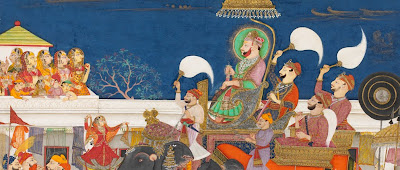
Have you ever seen a 409-carat emerald? I saw one yesterday that was literally the size of my chubby fist. My friend Alison and I went to see the exhibition on Indian royalty at the Victoria and Albert Museum, London. It was fantastic: five rooms full of the splendour of India's royal courts, which were, let's face it, pretty splendid. Luckily for us academic types, the V&A is a great museum that doesn't just put a load of pretty things in cases, and the notes and theme of the exhibition were very good. The nature of kingship and the social role of the king, as well as the way their power and identity shifted through time was dealt with.
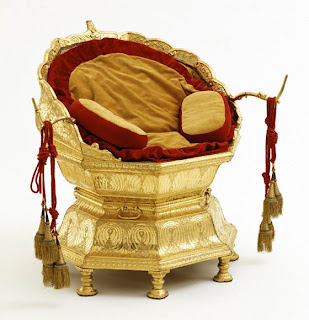
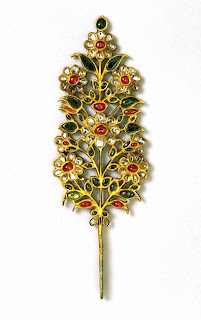
The exhibition began in the 18th century, post- the Great Mughals, after Aurangzeb had died and the dynasty and empire had begun to decay. The Marathas and Sikhs were establishing their presence, and the power of the European East India companies was growing. It explores their role in society, their rajadharma and the many duties that were expected of them. On display are their weapons, palanquins, howdahs for elephant-riding and other royal paraphernalia, along with giant gem covered turban pins and necklaces commissioned from Cartier. It carries on until the 20th century, where it ends, with the role of the Maharajas under the British. In a way it really was quite sad; they were forced to appear as European stereotypes of 'exotic' Indian rulers, puppets under the Raj. Post-Independence in 1947, they were guaranteed their privileges by the new Constitution of India. In 1971, then-PM Indira Gandhi took these away.

Now it's quite hard to feel sorry for people who had diamonds as big as the Ritz, but there's something very tragic about the Maharajas. They were born into privilege, but lived in gilded cage. They may have been mad wealthy, but they also patronised the arts in extraordinary ways, and some believe that traditional Indian music wouldn't have survived without them. I never really realised that they had played such a strong role in the development of the arts in India. The exhibition really made me look at the Maharajas in a different light, and if you can make it to the V&A, I think it'll do the same for you.
The Maharaja exhibition is on display in London until the 17th of January 2010. Tickets are £11 on the door and £6 for students. Click on the link below to have a look.

The Maharaja exhibition is on display in London until the 17th of January 2010. Tickets are £11 on the door and £6 for students. Click on the link below to have a look.
Don't worry if you're not in London in the next month, as much of this stuff is usually on display back home. Try to make your way to Mehrahgarh Fort in Jodhpur, where they have a wonderful collection.
Additonally, for fans of photography, this is a wonderful find to browse through.
Images show the procession of Ram Singh II of Kota, c. 1850; The golden throne of Maharaja Ranjit Singh, Hafiz Muhammad Multani, 1820-1830; and Turban ornament, early 18th century, made of gold, diamonds, rubies and emeralds. All copyright the Victoria and Albert Museum. Used with permission.
Subscribe to:
Comments (Atom)
